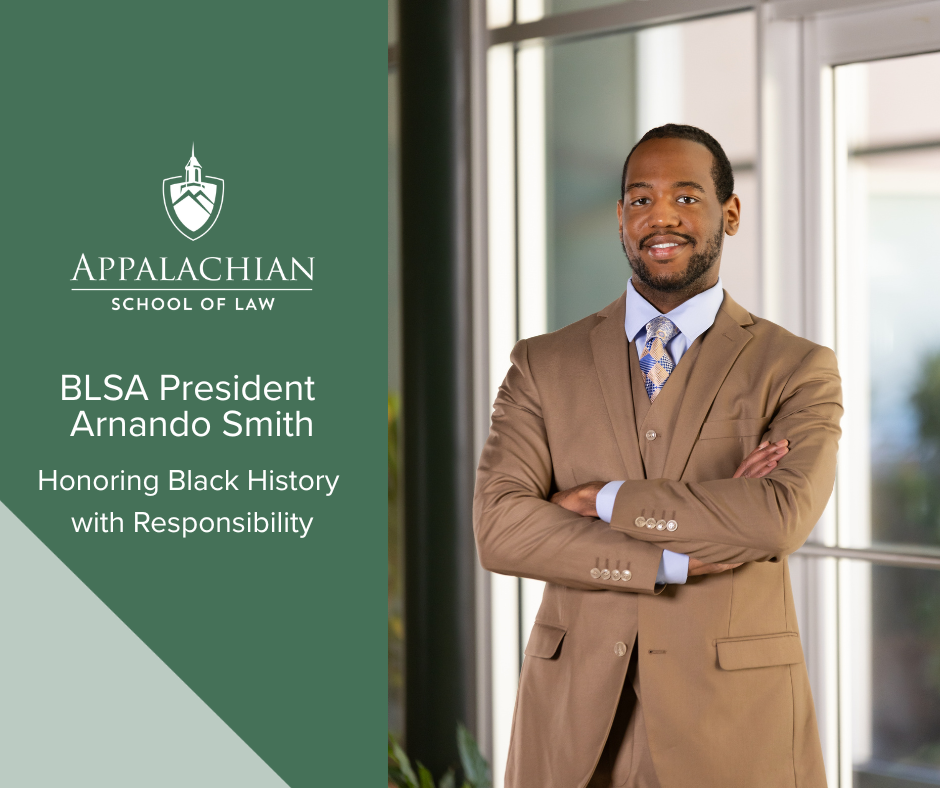
Dear Members of the Appalachian School of Law Community,
Black history, to me, is not an abstraction or a chapter in a textbook. It is personal. It is lived. It is the quiet strength passed down through generations who walked roads they did not choose so that I might walk roads they never could. It is the reason I am here in life and in law.
I come from a childhood marked by struggle, by instability, by scarcity, and by trauma that does not easily loosen its grip. I grew up learning resilience before I ever learned comfort. Yet even in those moments of fear, I was never without hope. I carried with me the legacy of ancestors who survived enslavement, segregation, and systemic exclusion, and who still believed, against all evidence, that education and the law could become instruments of liberation rather than control. The roads they traveled were hard, often unmarked, and rarely rewarded. But they cleared a path so I could reach the plight of pidea
African Americans have never advanced by accident. Progress has come because people chose to endure, to sacrifice, and to pursue opportunity even when the cost was high and the outcome uncertain. Dr. Martin Luther King Jr. captured this truth when he reminded us that “the arc of the moral universe is long, but it bends toward justice.” That bend is not inevitable; it is earned. It is earned by those who refuse to surrender their humanity in the face of injustice.
My own journey reflects that inheritance. Education and upward social mobility were not guarantees in my life; they were privileges carved out of persistence. Through learning, I found not only opportunity, but healing. Education gave language to pain, structure to chaos, and purpose to perseverance. It allowed me to confront and overcome the trauma of childhood and the scars carried home from military service and wartime experience. Where violence once narrowed my vision, education expanded it. Where survival was once the goal, ideas became the mission. And Striving became the vision.
Law school stands as a testament to that transformation. It is not merely an academic achievement. It is evidence of how far we have come, and of how deliberately African Americans have claimed space in institutions once designed to exclude us. Civil rights attorney Fred D. Gray, whose life’s work reshaped American jurisprudence, showed us that mastering the law is an act of resistance in itself. The law can restrain injustice, but only when people with conscience and courage are willing to wield it.
Yet this progress demands more than credentials. As Dr. Cornel West powerfully warns us, “If your success is defined as being well adjusted to injustice and well adapted to indifference, then we don’t want successful leaders. We want great leaders—who love the people enough and respect the people enough to be unsought, unbound, unafraid, and unintimidated to tell the truth.” Legal education must not simply refine us; it must require something of us. Truth-telling is not optional. Accountability is not abstract. Justice is not theoretical.
This journey also requires discipline. Denzel Washington reminds us, “Without commitment, you’ll never start. But more importantly, without consistency, you’ll never finish.” Black history teaches that resilience is sustained through repetition, through showing up day after day, generation after generation, even when recognition is delayed, and resistance is constant.
Black history lives in courtrooms, classrooms, and communities. It lives in the struggle to turn pain into principle and survival into service. My presence here is not mine alone. It belongs to every ancestor who endured so that possibility could exist, and to every future student who will need us to leave the door wider than we found it.
As members of this community, may we honor Black history not only with reflection, but with responsibility, by becoming lawyers who are courageous, compassionate, and unwilling to accept injustice as normal. May we use the law not as a shield for indifference, but as a tool for human dignity.
Respectfully
Smith, Arnando A.
A.A, B.S, Purdue University
U.S. Army Veteran (“Airborne”)
J.D. Candidate | Appalachian School of Law ’26
Office: +1 774-361-7994